At a glance
AI law firm marketing works best when SEO, answer-focused content, structured data, local signals, online booking, intake forms, and CRM follow-up operate together. AEO should help answer engines understand the firm clearly; it should not mean manipulating algorithms or promising visibility.
Search visibility is becoming a clarity problem
Law firm marketing used to be easier to describe: build pages, rank pages, get clicks. That model was already incomplete, and AI-assisted search makes the weakness more obvious. A prospective client may find a firm through Google, an AI-generated answer, a local map result, an email campaign, a referral link, or a blog article. The firm still needs SEO, but it also needs pages that are clear enough for people and machines to understand.
That is where AEO, or answer engine optimization, becomes useful when it is done honestly. It does not mean gaming AI systems or promising placement in an answer box. It means making the firm's services, locations, process, trust signals, FAQs, and next steps easier to parse. A page that clearly explains who the firm helps and how a consultation is requested will usually be stronger than a page filled with vague promises.
This is especially important for law firms because public content needs professional restraint. A practice page can explain the service and consultation path without diagnosing a visitor's legal problem. A blog can educate without giving advice. A FAQ can answer process questions without telling a reader what strategy applies. The best marketing copy is specific enough to be useful and restrained enough to remain professionally safe.
Google's people-first content guidance points in the same direction: publish useful, reliable material for people, not thin content created only to manipulate search. For law firms, that means real explanations, real process detail, real attorney review, and a clear path to consultation. AI can help create drafts, but the final content has to earn trust.
AEO is not a replacement for conversion work
Even the clearest article fails commercially if the visitor has no next step. A law firm needs visible calls to action, mobile-friendly booking, short intake, click-to-call where appropriate, disclaimers that set expectations, and CRM follow-up that keeps the request from disappearing. Marketing does not stop at the page view.
This is where many firms lose money. They invest in SEO, ads, or content, but the form is too long, the booking path is buried, the contact page is generic, or the CRM does not preserve source context. Then the firm cannot tell whether the campaign failed, the page failed, the intake failed, or follow-up failed. More traffic only amplifies that confusion.
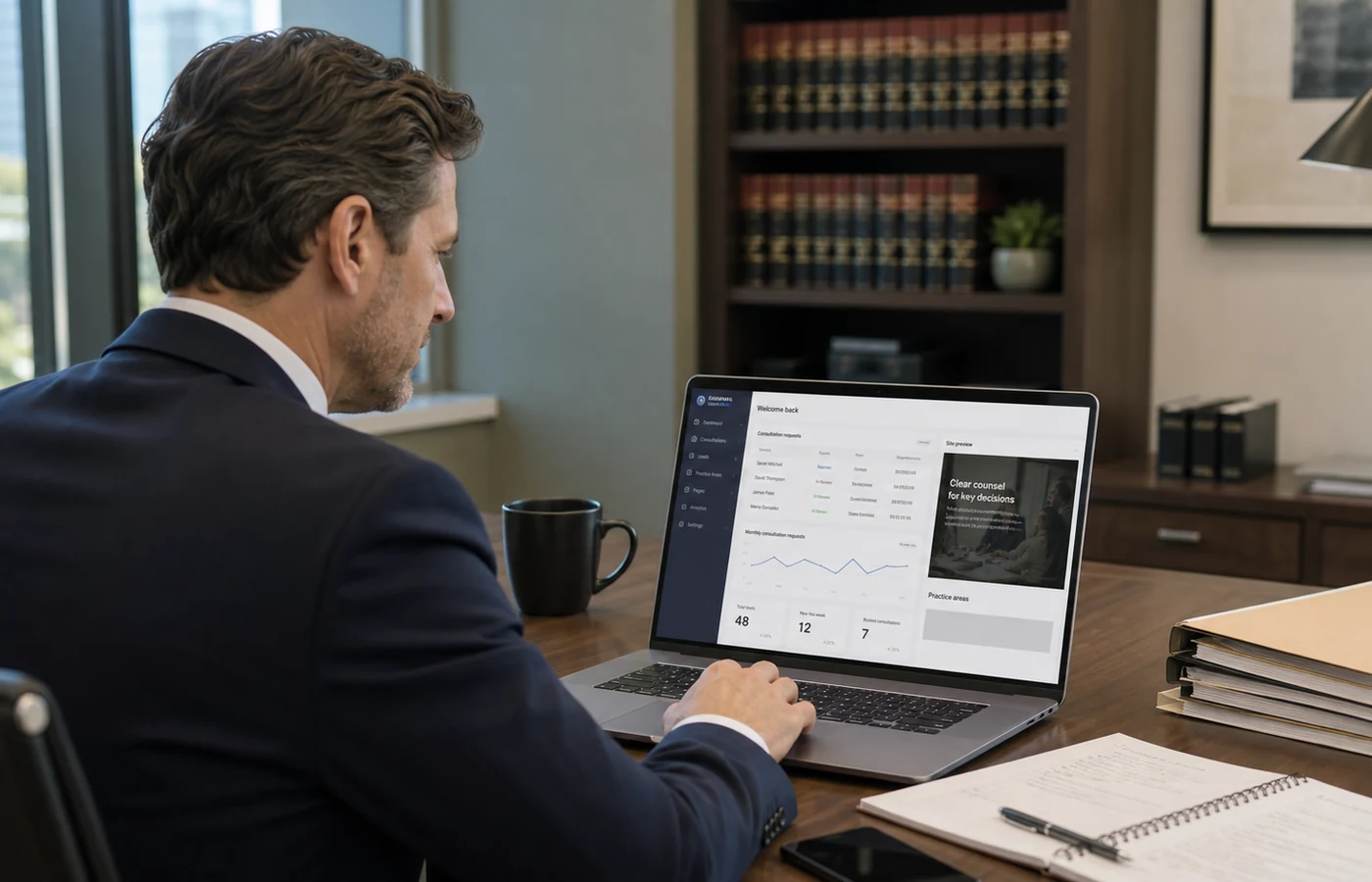
Legal Growth OS connects the public site to booking, intake, CRM, Legal AI, content review, SEO/AEO, landing pages, and follow-up. That connection lets the firm review a fuller picture: what pages attract interest, where visitors act, what leads are created, which requests are qualified, and what needs improvement. SEO without this operational layer can produce attention that the firm is not ready to handle.
The goal is not to turn every law firm into a marketing department. The goal is to give the firm a system that can be reviewed and improved. If mobile booking starts are weak, fix the layout. If a practice page gets traffic but no requests, clarify the offer. If blog readers never move to a service page, add stronger internal links. If lead quality is low, adjust the landing page and intake questions.
AI can help marketing when attorneys keep control
AI can speed up research notes, content outlines, FAQ drafts, metadata, landing page briefs, and monthly improvement ideas. It can also help review competitor pages supplied by the firm and identify missing trust cues or conversion friction. But AI should not invent claims, fake credentials, fabricate testimonials, guarantee rankings, or publish legal content without review.
The firms that benefit most will use AI as part of a reviewable content operation. A draft becomes an attorney-reviewed article. A SEO recommendation becomes a task. A landing page idea becomes a preview before publication. A FAQ becomes visible content and, where appropriate, structured data that matches what users can actually read on the page. This is slower than mass publishing, but it is safer and more durable.
Legal marketing is moving toward connected systems because the buyer journey is no longer linear. The same prospective client may read an AI answer, scan a practice page, open a blog, compare pricing, and book from a phone. A firm that connects SEO, AEO, intake, CRM, and follow-up is better prepared for that reality than a firm that treats search traffic as the finish line.
Next step
Build a marketing system that converts attention
Legal Growth OS connects websites, SEO/AEO, AI-search readiness, booking, intake, CRM, and follow-up so law firm marketing does not stop at the page view.
Questions answered
Frequently asked questions
Does AI search replace SEO for law firms?
No. AI search increases the need for clear service pages, structured answers, local signals, fast performance, and trustworthy content.
What is AEO for law firms?
AEO means structuring content so answer engines can understand the firm, services, FAQs, location signals, and next steps. It should be helpful, not manipulative.
Should every law firm page have FAQ schema?
No. FAQ schema should be used only when the FAQ content is visible, useful, and accurate on that page.
How does CRM affect law firm marketing?
CRM helps the firm track source context, intake answers, booking status, notes, tasks, and follow-up so leads do not disappear after submission.
Can AI write law firm marketing pages?
AI can help draft, organize, and suggest improvements, but public legal content should be reviewed by the firm before publishing.
Continue the path
Related platform pages
External references
Authority resources
SEO/AEO