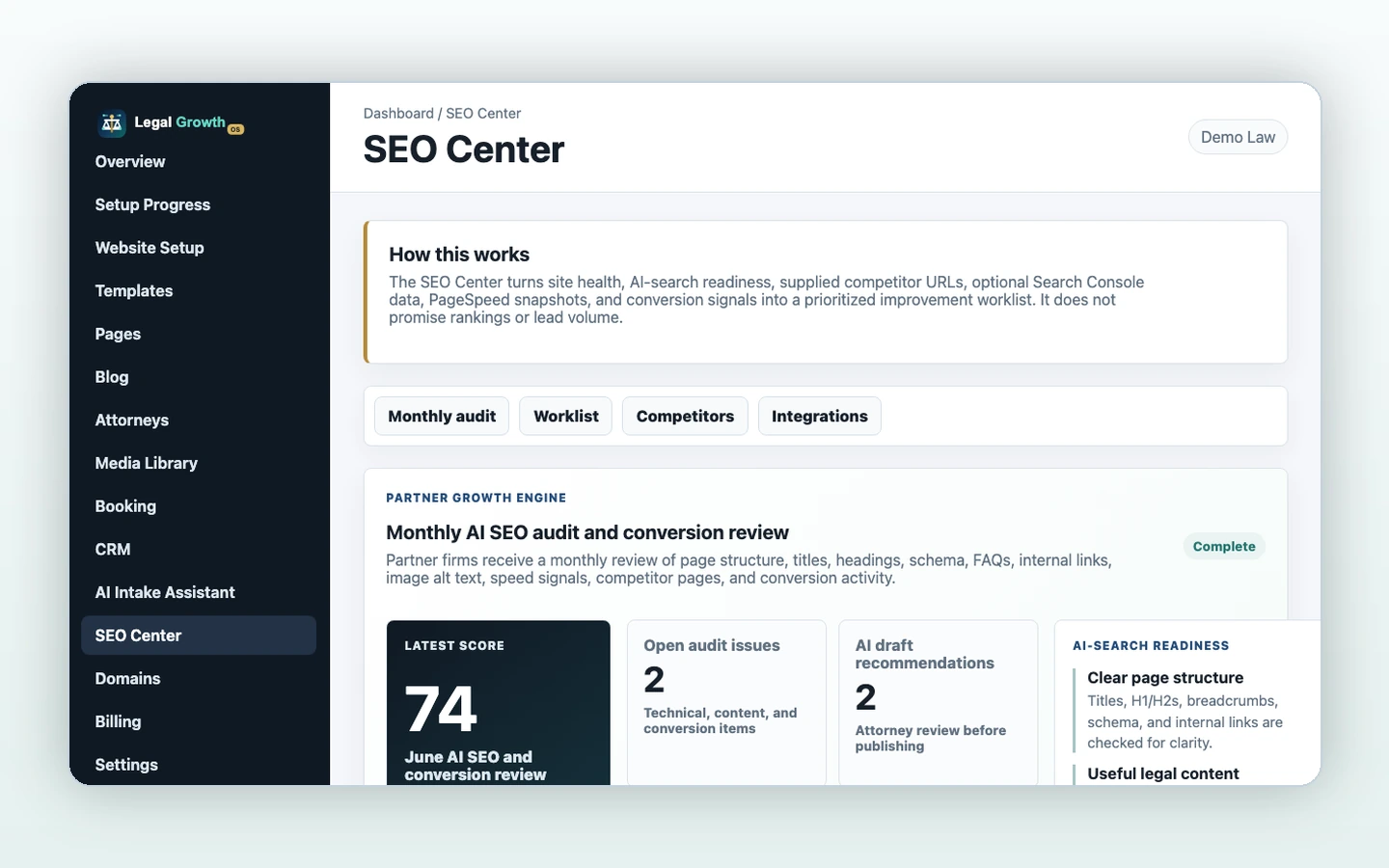
A monthly review should explain what changed and why it matters
Many SEO reports leave law firms with a list of numbers and no practical next step. A monthly review should do the opposite. It should explain which pages need attention, what is limiting clarity or conversion, and what the firm can approve next. The report should be written for decision-making, not for impressing the reader with jargon.
Rankings can be useful, but they are unstable and incomplete. Search results vary by location, device, personalization, query language, and platform. AI-assisted search adds another layer of interpretation. A responsible platform should not promise a number one ranking or guaranteed leads. It should help the firm improve the parts of the website it controls.
That means reviewing titles, meta descriptions, page headings, internal links, schema, sitemap status, image alt text, noindex settings, broken links, speed signals, Search Console data when connected, and conversion behavior from the site. The firm should finish the review with a prioritized worklist, not a mystery.
The review should also explain the tradeoff behind each recommendation. A short title may be clear but missing local context. A longer form may collect better intake detail but reduce completion on mobile. A landing page may have traffic but no leads because the CTA does not match the visitor's intent. Good recommendations describe the reason, not just the task.
Technical findings should become plain-language fixes
Technical SEO problems often sound abstract until they are tied to a page. Missing alt text is easier to fix when the audit shows the image, page, and suggested description. A weak title is easier to improve when the audit explains what service or location is unclear. A broken internal link matters more when the report shows which user path it interrupts.
A good review should separate quick wins from larger content decisions. Quick wins may include missing meta descriptions, broken links, duplicate headings, accidentally hidden pages, sitemap omissions, image alt text, or schema warnings. Larger decisions may include rewriting a thin practice page, adding attorney-reviewed FAQs, restructuring navigation, or refreshing a landing page that has traffic but weak conversions.
This distinction helps the firm act. Staff can handle some operational fixes, while attorneys review legal content, claims, disclaimers, and practice-specific language. The platform should make that separation clear so SEO work does not become an unsafe auto-publishing workflow.
Technical findings should also stay connected to the actual page editor. If the audit says a page has missing alt text, the media library should make it easy to update that image. If a page has weak metadata, the SEO panel should hold the draft update. If a published article needs a refresh, the new version should remain a draft until attorney approval.
Competitor comparison should be specific, not theatrical
Competitor review is useful when it compares real pages, not when it produces vague fear. A law firm can manually supply three to five competitor page links and review their page structure, titles, H1s, content depth, FAQs, local signals, attorney bios, schema, mobile layout, booking clarity, and CTA placement. The point is to learn from the market without copying it.
The review should also respect data boundaries. A platform should not scrape Google directly without an approved SERP API. If Search Console is not connected, the system should say so clearly. If PageSpeed data is unavailable, the review should still use site health and platform analytics. Honesty is part of product quality.
Competitor findings become useful when they create drafts or tasks. If competitor pages explain consultation preparation better, the system can suggest FAQ drafts. If the firm's local signals are thin, the system can recommend office detail improvements. If competitor pages have clearer booking CTAs, the system can suggest conversion changes. None of that requires promising rankings.
A firm should also choose competitors thoughtfully. The most useful comparison may be another local firm with a similar practice mix, not a national directory or a large firm with a different budget. The goal is to understand what prospective clients may be seeing elsewhere and where the firm's own pages can explain services more clearly.
Conversion data keeps SEO tied to revenue work
A law firm does not need more traffic for its own sake. It needs the right visitors to request consultations and move through follow-up. Monthly SEO reviews should include conversion signals such as visits, form starts, form completions, booking starts, booking completions, click-to-call events, CTA clicks, source data, device behavior, and CRM stage movement where available.
Those signals change the recommendations. If mobile form starts are strong but completions are weak, the form may be too long or difficult to use. If a page gets visits but no booking activity, the CTA may be buried. If a blog article attracts readers but never links to a service page, internal linking may be the next fix. Conversion context turns SEO from abstract reporting into practical growth work.
Legal Growth OS positions the Partner SEO engine around this combined view: technical health, content clarity, AI-search readiness, manually supplied competitor comparisons, and conversion recommendations. The output should be a worklist attorneys can review and approve, with legal content kept safely in the Draft to Attorney Review to Approved to Published workflow.
Over time, the firm can see patterns. Some pages may need clearer service explanations. Some may need shorter forms. Some may need better attorney bios or more local context. Some may not deserve more work because they attract the wrong audience. Monthly review is valuable because it helps the firm decide what to improve, what to leave alone, and what to test next.
Next step
Make monthly SEO reviews practical
Partner gives firms monthly AI SEO audits, competitor comparison, AI-search readiness review, and conversion recommendations that become attorney-reviewable improvement tasks.
Continue the path
Related platform pages
Legal AI